| Current Exhibition |
 |
 |
| WOOD ENGRAVINGS BY ERIC GILL 1882-1940 |
enter exhibition
|
Best remembered for his love of line and form, Eric Gill was one of the most prolific and controversial British artists of the last century. Calligrapher, stone-cutter, typographer, sculptor, engraver, essayist and even architect, Eric Gill’s work famously includes the fourteen Stations of the Cross in Westminster Cathedral and the Prospero & Ariel carving at Broadcasting House.
Gill’s lifetime’s work reveals the dual identity of a deeply religious man for whom the utilitarian function of art – and of flesh – weaves itself inextricably through both his personal and working life. Throughout his career Gill was forever challenging high art principles in favour of craftsman-like simplicity and honesty, devoting his entire life to integrating work and leisure, art and industry, flesh and spirit.
Eric Gill was born in Brighton in 1882 into a large family, the eldest son of clergyman, Arthur Tidman Gill and his wife Rose, a former professional singer. Early adolescent drawings reveal an enthusiasm for line and symmetry but also a fascination with things mechanical; he shared with his father a love of contraptions and it is possible to surmise that, even at an early age, the problem-solving craftsman in Gill was never far from the surface.
The family moved to Chichester in 1897 where Gill enrolled at Chichester Technical and Art School. Here under George Herbert Catt he began to learn the finer points of lettering. Two years later he moved up to London as an apprentice in the Westminster office of the architect, W.D. Caröe, the big gun of church architects as Gill called him. Here Gill trained in architectural drawing and building techniques – skills he upheld to be invaluable to every type of artist; the three years he spent with Caröe were also to play a significant role in shaping Gill’s own lifelong view that it all goes together. It was during this time that he was introduced to one of his most influential mentors, George Carter. Carter encouraged Gill’s own views that the role of public architecture lay in uniting the secular and the sacred, something Gill went on to realise in full in his designs for a church in Norfolk, St. Peter the Apostle.
Crucial to his later development as an artist, Gill also began to attend the Central School of Arts and Crafts. Under the expert tutelage of Edward Johnston he learned much about lettering, masonry and the techniques of stone-cutting. Having received a number of commissions for lettering he parted company with W.D. Caröe in 1903. At the end of the year work for W.H.Smith & Son took him to Paris where he painted the fascia of the shop on the rue de Rivoli.
In 1904 Gill married Ethel Moore, later to be known as Mary, and after a brief spell in Battersea they began the first of their many and varied household moves, this time to Hammersmith. Gill and his family - they went on to have three daughters and an adopted son - continued to travel across England in pursuit of the ultimate domestic idyll; a monastic and communal way of life where spiritual inspiration, workmanship and industry flourished.
The draw of Hammersmith for Gill was that there already existed a strong arts and crafts community – a movement that celebrated the craftsman’s skill and favoured the hand-made over the mass-produced. Amongst those living in Black Lion Lane at the side of the Thames were the Johnstons, the Walkers, May Morris and the Peplers. It was with Hilary Pepler that Gill formed the closest bond – a relationship that lasted many years, but eventually fell apart owing to differences of opinion, mainly over money. In this thriving arts and crafts community husband and wife collaborations were also common; Gill for example carved decorative mirrors which Mary gilded. Gill’s ingrained Victorian mindset and ‘conscious maleness’ added some degree of hypocrisy to this otherwise idyllic scene. He soon established a workshop at the side of the house to pursue the more masculine tasks of letter cutting and stonemasonry with assistance from his first apprentice, a very young Joseph Cribb. In these convivial workshop surroundings Gill’s natural ability as a teacher figure were allowed full vent, the workshop providing an ideal forum for Gill to expound his many views on both social and spiritual issues.
After Hammersmith the family moved to Ditchling in Sussex; Pepler followed later and by 1916 had established the St. Dominic’s Press. The years spent at Ditchling saw the flowering of Gill’s talents as wood engraver and ‘his mastery of linear communication’. Encouraged by Count Harry Kessler, the publisher and patron of the visionary theatre designer and printmaker, Edward Gordon Craig, Gill’s first attempts were made in 1908, a year or so before he produced his first sculpture. Early works were mainly of a religious nature and often for St. Dominic's but towards the end of his time in Ditchling Gill produced a rather ambiguous series of life studies of his daughter Petra – the girl in the bath. With his characteristic cross-hatching, these drawings are a celebration of the female form entering adolescence. The relief shading, ‘like a nimbus around the limbs’ is reminiscent of the chiaroscuro effect in Renaissance painting and whether intentional or not this illuminated quality has the effect of elevating the simple nude figure into the realm of the sublime. Many of the prints made at this time are amongst the best that Gill produced.
The sexual undertones evident in the studies of his daughters seep into his religious iconic work; Divine Lovers in particular was inspired by Art & Scholasticism – an interpretation of St. Thomas Aquinas’ teachings - for which Gill provided illustrations. In 1913, Gill converted to Roman Catholicism, in particular the teachings of St. Thomas Aquinas. It was in the Order of the Dominicans that Gill found sense and reason combined, which in turn justified his growing belief that ‘sexual intercourse is the very symbol for Christ’s love for His Church, His Bride’. This is perhaps best depicted in his wood engraving, Nuptials of God and in the erotic life drawings that formed the basis of his wood engravings for Twenty-Five Nudes, completed at High Wycombe in 1937.
Gill’s fascination with wood engraving makes sense; the medium appealed to his sensibilities as a craftsman. As an advocate of self-sufficiency he was even known to have advised his apprentices to fell their own trees to make woodblocks! Every stage of the process was controlled by the craftsmen making this an efficient and cost-effective way of working and ensuring that Gill could master the medium – for Gill, this was everything: the discipline of technique is at the heart of doing things well. Although Gill was probably financially secure, wood engraving during the Capel-y-ffin years and later into the 1930s must have provided him with a steady source of income. The fashion for collecting prints and livres d’artistes was at its height in the late 1920s and Gill’s illustrations for the Golden Cockerel Press, especially for Troilus and Criseyde, The Canterbury Tales and The Four Gospels received huge acclaim.
Eric Gill’s physical and spiritual journeys reflect his innate, sometimes deviant curiosity, his restless yet tireless sense of self-discovery and his fickle but passionate allegiances, all of which led him to produce a phenomenal amount of work right up until his death in 1940. For Gill – as revealed in his autobiography – it was always about achieving his ultimate goal: to create a cell of good living.
Lucy Lott
In writing the above and describing the individual prints we have made reference to the following:
Gill, Eric. Autobiography. Jonathan Cape, London, 1940.
Physick, John. Catalogue of the Engraved Work of Eric Gill. Victoria and Albert Museum, London, 1963.
Yorke, Malcolm. Eric Gill Man of Flesh and Spirit. Constable, London, 1981.
MacCarthy, Fiona. Eric Gill A Lover's Quest for Art and God. Faber and Faber, London, 1989
enter exhibition
|
|
| |
|
| Previous Exhibitions |
|
|
 |
 |
| THE ETCHINGS OF ROBIN TANNER 1904-88 |
enter exhibition
|
March 2007
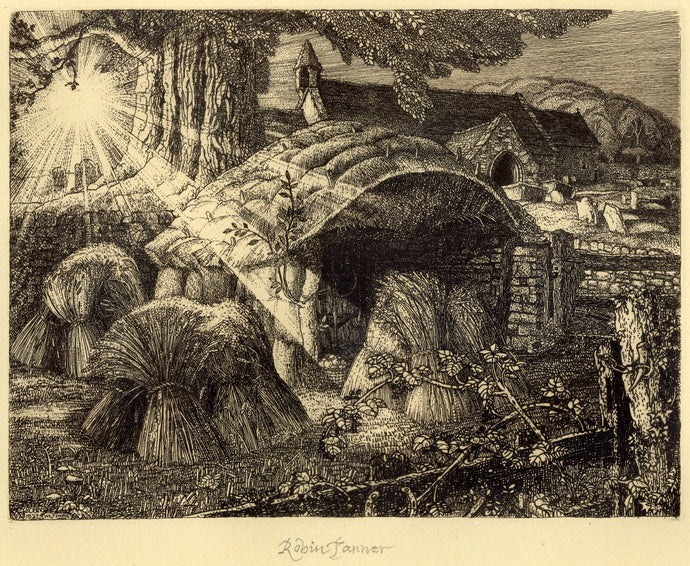
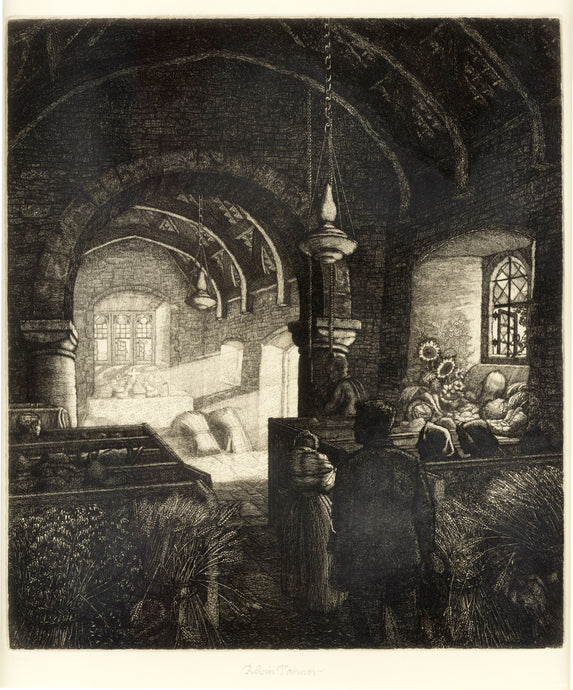
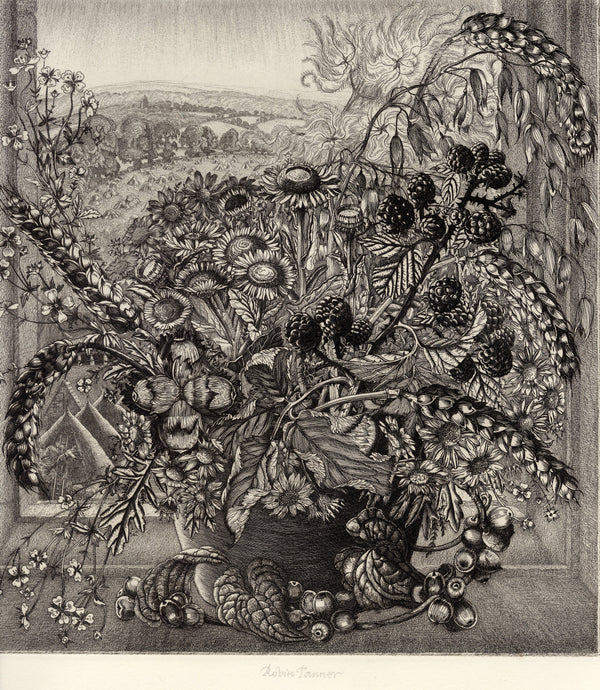
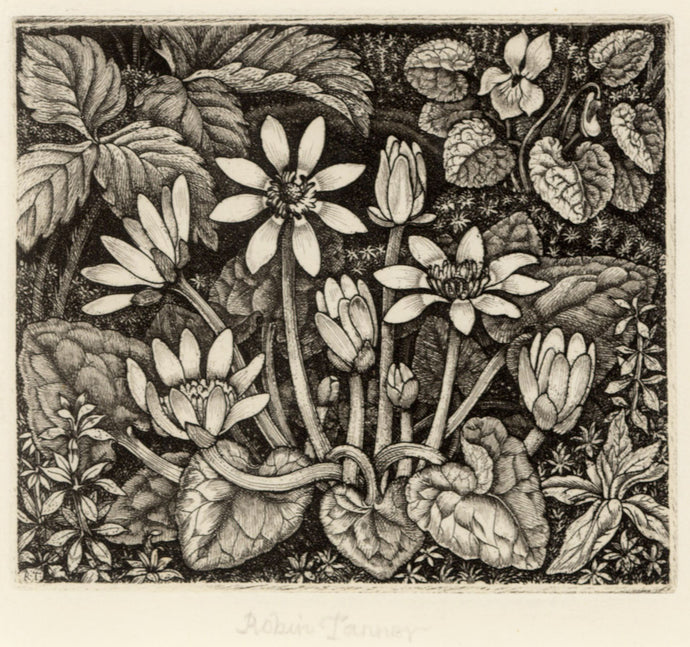
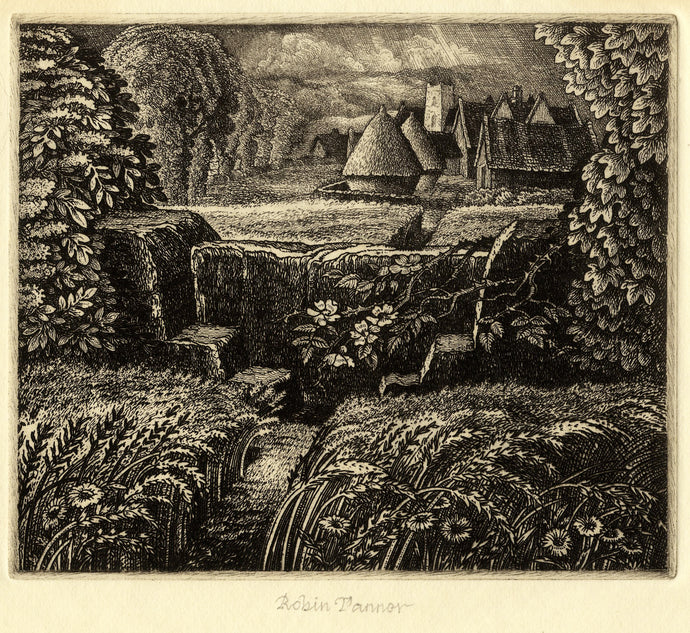
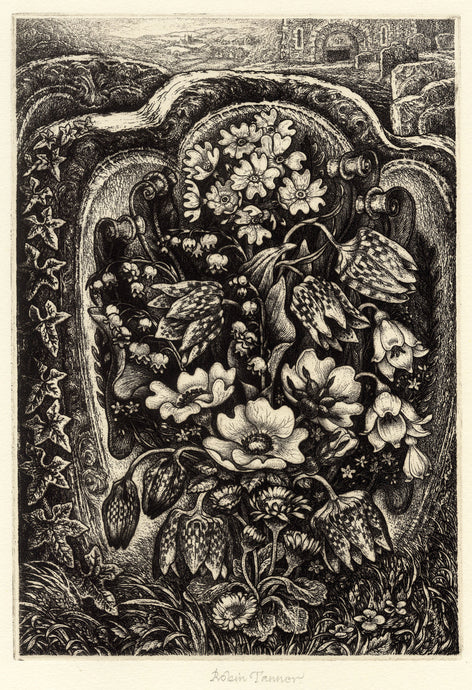
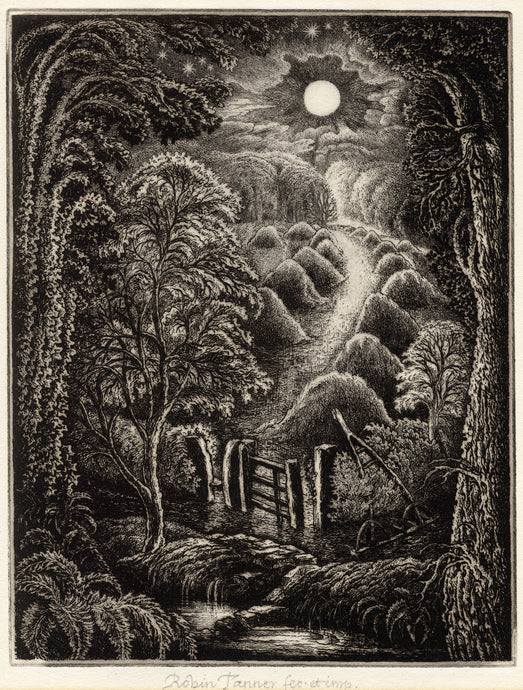
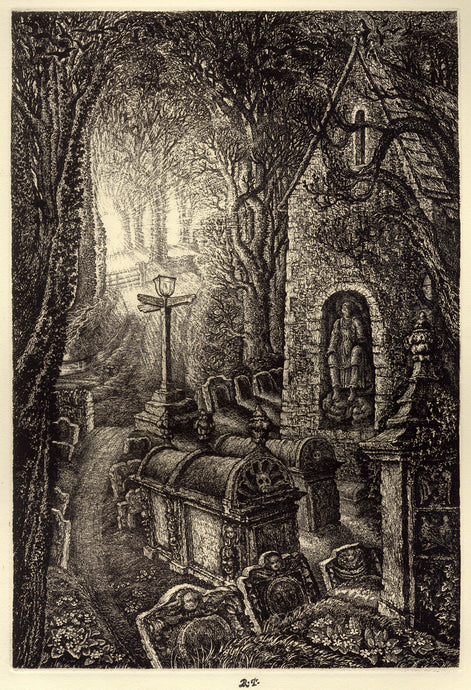
Tanner was born in Bristol in 1904. He trained as a teacher and in the early 1920s attended evening classes at Goldsmith’s College with fellow students Graham Sutherland and Paul Drury. In 1926, all three visited the first retrospective exhibition of Samuel Palmer’s work at the Victoria and Albert Museum; the sight of Palmer’s early visionary masterpieces would influence Tanner for the rest of his life.
He returned to Wiltshire in 1928 and began to etch full time but unfortunately, owing to the onset of the depression, was forced to resume his career in teaching. His appointment as H.M.Inspector of Schools necessitated a move to Leeds but by 1937 he was back at Kington Langley near Chippenham where he remained for the rest of his life. Some of his best etchings were made before the Second World War; Christmas, Harvest Festival, Autumn and Wiltshire Rickyard all feature in this exhibition. During the latter part of the 1930s Tanner and his wife Heather were working on a new book, Wiltshire Village, which had been commissioned by Collins; Robin provided the illustrations. As the couple described, it told the story, not of any one village, but rather an epitome of some of the villages of North-West Wiltshire. The book was a best seller, was reprinted as late as 1978 and is still popular today.
By 1946 he had etched twenty-three plates, but it was not until after his retirement in 1964 that he could finally indulge his passion for printmaking. He completed another twenty-eight during his lifetime invariably printing most of the impressions himself. This exhibition features approximately two-thirds of Tanner’s recorded output. Many of the images not included remained unpublished and can no longer be found.
During his life as a schools inspector Tanner lectured on many aspects of children’s education. His love of Blake and Palmer, his admiration for the ideals of William Morris and the Arts and Crafts movement, perhaps even his knowledge of the work of the great Cotswold etcher and conservationist, F. L. Griggs, all influenced his work both as an artist and a teacher. A love of country matters and a respect for many of the associated customs and traditions were values he believed should be passed on to children and teachers alike. His impact was widespread in the south-west of England and his views on education and preservation touched many people.
Tanner’s passionate interest in the British Crafts Movement lead to friendships with a number of influential figures, the potters, Hans Coper and Lucie Rie amongst them. In later life he was instrumental in the formation of the Crafts Study Centre, once housed in the Holburne Museum of Art in Bath, but now firmly established in Farnham, Surrey. The Tanner Gallery therein is a permanent memorial to this very English of artists.
Throughout his career Robin Tanner remained true to the English pastoral tradition. Although at odds in later years with the artistic mainstream, his love of traditional country crafts and the Wiltshire environment in which he lived, made his contribution to the history of British printmaking particularly significant. |
|
 |
 |
| BEN NICHOLSON - The Later Etchings 1965-1968 - Proofs from The Lafranca Collection |
enter exhibition
|
May - June 2007
It is twenty-five years since Nicholson’s death and in that time there have been few attempts to assess in any detail his achievements as a graphic artist. While this is beyond the scope of the present exhibition, it is interesting to note how such a large body of work produced over so long a period of time has been largely disregarded by most present-day commentators. There are exceptions; Norbert Lynton in his monograph on Nicholson published in 1993 gave some space to the etchings and of course Jeremy Lewison wrote a splendid article in Print Quarterly in 1985 but this dealt only with prints made before 1939. Hopefully his work in the future will extend to a study of the later etchings.
Nicholson’s graphic output was far from small; he made a number of linocuts in the late 1920s and early 1930s, a group of drypoints in the late 1940s and early 1950s and finally, in his most prolific period, more than one hundred and thirty etchings between 1965 and 1968. The majority were done in a concentrated period of activity in 1967. What prompted him to return to printmaking in 1964-5 is not entirely clear; François Lafranca thinks he had been asked to provide a couple of drypoint illustrations for a book. The drypoints were quite large however, casting some doubt on this hypothesis and in any event the plates were soon abandoned. At Lafranca’s suggestion Nicholson turned his hand to etching instead.
In 1965 François Lafranca was a young Swiss artist and would-be printer; today he is an accomplished all-rounder, a sculptor, a print and paper-maker, a photographer, a musician, a gardener and a fine cook. Without his encouragement and assistance Nicholson would never have made an etching; he simply did not possess the skills to prepare, bite and print the plates, nor I suspect, did he have the inclination. He wrote in 1968, I think I am not an “etcher” as I understand the medium at all – really to be this one should know and have the whole paraphernalia – prepare and print the plates oneself……I suppose mine [his etchings] are really drawings on prepared copper. When Nicholson met Lafranca he was living at Brissago, in a house he had built overlooking Lake Maggiore. He had come to Switzerland in 1958 with his third wife, Felicitas Vogler, by this time a well-known and accomplished photographer. Their travels together in Italy and Greece inspired numerous drawings and etchings; on occasions it seems likely that Vogler’s photographs may have provided the source.
Nicholson would always decide on the shape and size of his plates; mostly they are irregular. According to Lafranca, scratches in the plate, variations in inking, happy accidents, were all used to great advantage; Nicholson rather relished the unexpected. Lafranca was responsible for preparing and biting the plates and of course he printed them all. Some editions were issued with and without tone, usually in roughly equal parts. Editions of some plates were destroyed in their entirety or never made at all, although in most cases the odd proof has survived. At random Nicholson would select impressions to be hand-coloured or modified in some way. Both artist and printer respected the need to eventually destroy the plates; typically Lafranca was more fastidious in this endeavour, scoring the plates with a fairly regular diagonal grid; Nicholson’s method was more frenetic; he sometimes attacked them with a hammer and apparently enjoyed cutting them up on a guillotine. I have seen about sixty cancelled plates and several are exhibited here. I suspect the rest have long since disappeared; portions of some may have been used by other printmakers working with Lafranca at a later stage; a number were certainly scrapped. In his catalogue of the memorial exhibition of etchings held in Locarno in 1983 and later in Mannheim, Lafranca describes one hundred and twenty seven prints. For reasons best known to the artist more than a third of these had never been published. Many had not gone beyond the proof stage and in some cases Nicholson had ordered the destruction of whole editions. Another eight plates have since come to light; these too had been abandoned for one reason or another and with one exception, it appears that no impressions have survived. All these proof impressions are extremely rare and many are the equal of their published counterparts. We are pleased to have the opportunity to offer at least a few for sale.
A small group of cancelled copper plates will be on display and several will be for sale; details are available on request.
Nicholas Lott.
In describing the individual prints we have made reference to the following:
Lafranca, François, Ben Nicholson – Etchings printed by François Lafranca,
Ateliers Lafranca, Locarno, 1983.
|
|
 |
 |
| THE ETCHINGS OF WALTER SICKERT 1860-1942 |
enter exhibition
|
Nov - Dec 2007
It is only in recent years that the true significance of Sickert’s work as a printmaker has been appreciated by a wider audience. The exhibition at the Yale Center for British Art in New Haven, Connecticut in 1979 and the appearance of Ruth Bromberg’s catalogue raisonné have shown us the range and extent of his graphic output. The somewhat ephemeral nature of his early etchings, in particular those inspired by the teachings of Whistler, explains to some degree why recognition was slow in coming. Even Sickert himself was conscious of his own position when he admitted to a friend in 1907 that his etching, Noctes Ambrosianae, was, one of not more than half a dozen museum-pieces that I have done in twenty-seven years.
If Whistler’s influence was responsible for much of Sickert’s early work then real inspiration came later through his friendship with Degas. Sickert’s subsequent mature etchings of music halls and the seedy side of urban life in Islington and Camden Town mirrored to some degree the French master’s monotype studies of intimate interiors and Parisian brothels. The fascination with the more squalid aspects of ordinary modern life remained a prominent feature of Sickert’s work for the rest of his life.
While commercial success from printmaking eluded him in the 1880s it was probably a lack of money that drew Sickert back again to the medium in 1905. For ten years he struggled for recognition but ultimately without the critical acclaim and the financial reward he so deserved. He wrote to his American friend and patron, Ethel Sands, I have always known that I was, potentially, the only living etcher, but I was quite prepared never to prove it. It was throughout this period of course that he produced his finest prints. At a time when retroussage and heavy burr were being served up in great quantities by the likes of Cameron, Bone and McBey, the delicately clean-wiped, almost abstract offerings of Walter Sickert, laced as they were with intricate patterns of light and shade, were far removed from the fashionable requirements of the day.
Sickert was one of the great British artists of the twentieth century; in accepting the influence of the Impressionists he altered the course of British painting. As a printmaker he was a little less influential perhaps but did produce a body of work that is uniquely his own both in subject matter and style. He was eclipsed in the market-place often by the less-deserving heavyweights of the day; by the time of the crash in 1929 he had given up printmaking altogether. Sickert died in Bathampton on 22 January 1942.
|
|
|
| |
|